


 Free Newsletter

DEPOSITPHOTOS
General Assembly passes bill limiting noncompete enforceability for terminated employees
Jason Boleman//March 30, 2026//


Summary:
- Senate Bill 170 limits noncompete enforceability without severance
- Sen. Jeremy McPike, D-Woodbridge, patroned the bill
- Employers face $10,000 civil penalty per violation under new law
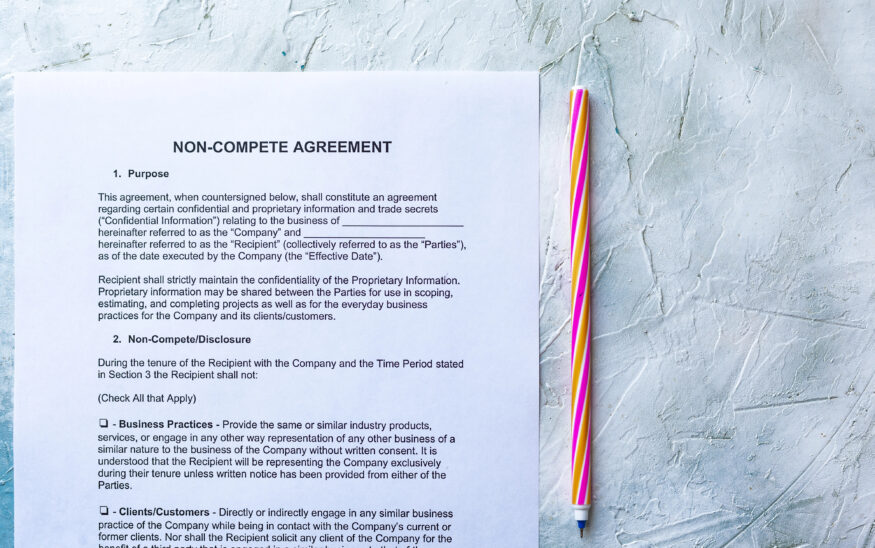
A bill to further limit the enforceability of noncompete agreements for certain terminated employees is heading to the desk of Gov. Abigail Spanberger.
If signed, Senate Bill 170 would add subsection C to Va. Code § 40.1-28.7:8, stating that a noncompete agreement between an employer and employee is not enforceable “if such employer discharges such employee from employment without providing severance benefits or other monetary payment to such employee, unless such employer discharges such employee for cause.”
Under SB 170, the severance benefits must be disclosed upon execution of the noncompete agreement.
The bill will also allow an employee to bring a civil action against a former employer who violates the section, broadening the language from just “low-wage” employees being able to file suit under the current statute.
Employers who violate the terms of the new subsection can be subject to a civil penalty of $10,000 per violation under Virginia law.
The bill continues a trend in federal and state governments embracing a push toward restricting the use of noncompete agreements by employers, most notably with the ultimately unsuccessful 2024 Federal Trade Commission rule that sought to ban noncompetes nationally.
In Virginia, the General Assembly passed a bill in 2025 to expand the definition of “low-wage employee” to an employee entitled to overtime compensation under the Fair Labor Standards Act, making all employees classified as “non-exempt” under the FLSA barred from having noncompetes enforced against them.
McLean attorney Declan Leonard, who leads the employment law practice at Berenzweig Leonard, said he anticipates Spanberger will sign SB 170 into law.
“SB 170 would be a seismic development in Virginia employment law and would continue the trend started in the summer of 2020 in which Virginia is being made into an employee-friendly state,” Leonard
said.
Alexandria attorney Tom Spiggle, founder of The Spiggle Law Firm, called the bill “a massive win for Virginia workers and a fundamental shift in how we handle post-employment restrictions.
“For years, employers have used noncompetes coercively — firing employees without cause yet still weaponizing these agreements to lock them out of their industry,” Spiggle said.
SB 170
SB 170 was patroned by Sen. Jeremy McPike, D-Woodbridge, and later incorporated SB 569 from Sen. Glen Sturtevant Jr., R-Chesterfield County. Sturtevant’s bill covered similar ground but added that an employee who is separated from their employment “shall be presumed to be involuntarily separated from employment unless the employer provides documentation establishing that such separation is voluntary or due to the employee’s inadequate job performance or misconduct.”
The bill sailed through the Senate, reporting from the Senate Commerce and Labor Committee unanimously on Feb. 2 and passing the Senate unanimously via block vote on Feb. 6.
“The problem that we’re solving is with the constituents who have been terminated, not for cause but for reduction in force or [without cause], but they all still had a noncompete in place,” McPike said to the committee. “So, they’re essentially out in the street.”
Capital One and the Virginia Chamber of Commerce both spoke in favor of the bill before the Commerce and Labor Committee.
The bill faced similar broad support in the House of Delegates, reporting unanimously from the House Labor and Commerce Committee on Feb. 24 and 18-4 from the House Appropriations Committee on Feb. 27.
The House of Delegates passed SB 170 on an 87-12 vote on March 4, sending the bill to Spanberger, who has until April 13 to take action on the legislation.
If signed by Spanberger, the bill would affect only noncompete agreements entered into after July 1, when the legislation would become effective.
Impact
Although he called the moniker “overblown,” Leonard said that SB 170 continues a trend that has led to some calling Virginia “the California of the East” for becoming more employee friendly.
Spiggle said that the important takeaway from SB 170 is its broad application. Notably, the bill removes all references to “low-wage” workers in the code section, clearing the way for all workers who want to bring action.
“The crucial detail is that this law applies broadly to all employees, not just low-wage earners, and there is no exception for the sale of a business,” Spiggle said.
Spiggle added that SB 170 “drastically changes the litigation landscape.”
The bill, he said, “creates a private right of action with a two-year statute of limitations, allowing us to sue for injunctive relief, lost compensation and attorney’s fees when employers try to enforce invalid agreements.”
Often, Leonard said, an employer will seek to avoid labeling a termination as “for cause” in order to make a separation between employer and employee more amicable.
But “SB 170 would cause employers to rethink this approach, since avoiding a ‘for cause’ termination will invalidate a noncompete agreement unless the company is willing to pay the employee during the noncompete period,” Leonard said. “It begs the question, ‘Why would a company pay an employee who was otherwise a poor performer just to keep the noncompete in effect?’”
At issue as well is what constitutes a “for cause” termination. In decades of practice, Leonard said, he has seen a variety of different definitions for the term in employment agreements.
“SB 170, if passed, will force companies to adopt the definition of ‘for cause’ specifically laid out in that law if they want to operate within the statute and keep their noncompete intact,” Leonard said.
For employees, Leonard said, the law change would incentivize challenges to “for cause” terminations to get them categorized as terminations without cause or layoffs “to try to get severance for abiding by the noncompete.”
“Companies will need to step up their game in terms of documentation in support of a ‘for cause’ termination if they want to keep their noncompetes alive without having to pay severance,” Leonard said.
Spiggle highlighted the severance piece as key to the legislation, which mandates that employers must be upfront about severance benefits before an employee signs a noncompete agreement.
“The biggest takeaway from SB 170 is that it forces employers to put their money where their mouth is,” Spiggle said. “If a company wants to restrict a worker’s mobility after firing them without cause, they must now provide severance benefits, and those terms must be disclosed upfront when the agreement is signed.”
Related Articles
Related Content










Verdicts & Settlements
- Motor Vehicle Negligence – Unicycle rider dies after being hit by car
- Premises Liability – Delivery driver injured by porch decking collapse
- Premises Liability – Fall down stairs at resort results in injuries, death
- Medical Malpractice – Jurors side with doctor in suit over rescue surgery
- Workers’ Compensation- Seasonal worker paralyzed in tobacco baler accident
- Medical Malpractice- Death from cancer followed stomach pain misdiagnosis
- Workers’ Compensation – Struck in face by forklift, woman suffers brain injury
- Negligence and Tort – Group home resident falls, sustaining femur fracture
- Medical Malpractice – Nursing facility patient dies after fracturing ankle in fall
- Medical Malpractice- Patient has bladder injury during colostomy reversal
- Premises Liability- Apartment guest burned by gas grill spewing fire
Opinion Digests
- The Most Important Opinions, January-June 2026
- Criminal – Court of Appeals wrongly vacated murder conviction
- Tort – U.Va. prevails on former professor’s claims
- Constitutional – Company’s due process claim against county is dismissed
- Administrative – Plaintiffs’ effort to enjoin ITC proceeding fails
- Patent and trademark – Amazon patent infringement suit transferred to New Jersey
- Tort – Chesterfield County dismissed from wrongful death suit
- Consumer Protection – Lawsuit over kratom survives motion to dismiss
- Criminal – Defendant convicted of attempted sexual exploitation of a child
- Evidence – Motion to exclude transmission expert is rejected
- Damages – Court awards pre-judgment interest following parties’ acquiescence
- Employment – Court approves overtime wage collective action settlement
