


 Free Newsletter

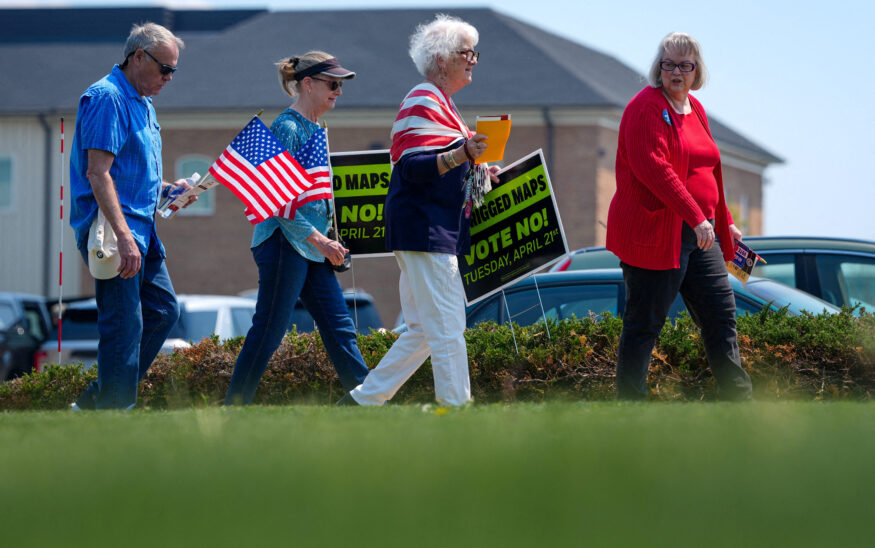
Supporters depart a campaign rally against Virginia Democrats' proposed state redistricting constitutional amendment ahead of the referendum special election on April 21, in Bridgewater, Virginia, April 11, 2026. REUTERS/Ken Cedeno/File Photo
Virginia Supreme Court overturns redistricting referendum vote in 4-3 ruling
A blow to Democrats, decision has national implications
Kate Andrews and Jason Boleman//May 8, 2026//


Summary:
- Virginia Supreme Court rules 4-3 to overturn referendum
- Justice D. Arthur Kelsey authors majority opinion
- Chief Justice Cleo E. Powell dissents on election definition
The Supreme Court of Virginia on Friday threw out a constitutional amendment recently approved by voters that would have allowed the General Assembly to redraw Virginia’s congressional maps to give Democrats an advantage in all but one of the commonwealth’s 11 congressional districts.
The 4-3 decision carries national implications as multiple states across the country have pursued mid-decade redistricting ahead of the 2026 midterm elections, where both parties have aimed to position themselves to win a majority in the U.S. House of Representatives, which currently has a slim Republican majority.
Justice D. Arthur Kelsey authored the high court’s majority opinion, writing that “the legislative process employed to advance the proposal violated Article XII, Section I of the Constitution of Virginia.”
“This constitutional violation incurably taints the resulting referendum vote and nullifies its legal efficacy,” Kelsey wrote.
Kelsey also referenced the delay in the court reaching this decision, which came 17 days after voters approved the referendum by a 2.9-point margin.
“It is fair to ask whether we could have or should have reviewed the constitutionality of the proposed amendment prior to it being presented to the voters,” Kelsey wrote.
Chief Justice Cleo E. Powell wrote a dissenting opinion joined by Justices Thomas P. Mann and Junius P. Fulton III.
“[T]oday the majority has broadened the meaning of the word ‘election,’ as used in the Virginia Constitution, to include the early voting period,” Powell wrote. “This is in direct conflict with how both Virginia and federal law define an election.”
Powell wrote that the legislature’s statutory definition of “general election” states that it is “any election held in the Commonwealth on the Tuesday after the first Monday in November.”
“Taken as a whole, Code § 24.2-101 clearly establishes that the General Assembly, in the exercise of its constitutional power to determine the time and manner of conducting elections, chose to limit elections to a single day,” Powell wrote.
Virginia Attorney General Jay Jones, a Democrat, criticized the court’s majority, saying the four justices had “chosen to put politics over the rule of law by issuing a ruling that overturns the April 21 special election on redistricting. This decision silences the voices of the millions of Virginians who cast their ballots in every corner of the commonwealth, and it fuels the growing fears across our nation about the state of our democracy.
“The Republican-led majority of the Supreme Court of Virginia contorted the plain language of the Constitution and Code of Virginia to give it a meaning that was never intended, which allowed them to reach the wrong legal conclusion that fit their political agenda. The consequences of their error are grave.”
Jones concluded his statement by saying that his office is “carefully reviewing this unprecedented order, and we are evaluating every legal pathway forward to defend the will of the people and protect the integrity of Virginia’s elections.”
Gov. Abigail Spanberger, who campaigned for the “yes” side during the referendum’s early voting period but was not required to sign off on the legislature’s actions to place it on the special election ballot, said in a statement she was “disappointed” in the ruling.
“More than 3 million Virginians cast their ballots in Virginia’s redistricting referendum, and the majority of Virginia voters voted to push back against a president who said he is ‘entitled’ to more Republican seats in Congress with a temporary and responsive referendum. They made their voices heard,” Spanberger said in the Friday statement. “I am disappointed by the Supreme Court of Virginia’s ruling, but my focus as governor will be on ensuring that all voters have the information necessary to make their voices heard this November in the midterm elections, because in those elections we — the voters — will have the final say.”
Majority ruling’s reasoning
Kelsey, in his majority opinion, added that the commonwealth “has insisted that we cannot lawfully decide this case prior to the referendum” being voted on.
“[I]t might be tempting for the Commonwealth to think that the final vote implicitly stacks the deck in its favor — perhaps enough so that the exercise of any judicial review could be viewed as an ultra vires effort to overturn the will of the people,” Kelsey wrote. “If this supposition were true — that Scott [v. James] forbids pre-election challenges and that ‘the will of the people’ forbids post-election challenges — the judicial review of allegedly unconstitutional procedures used to adopt a constitutional amendment would not exist in the Commonwealth of Virginia.”
The majority found that the process to amend the process, which details that the General Assembly must vote in favor of a proposed amendment at two separate legislative sessions with an intervening House of Delegates election between, was violated.
In this case, the General Assembly voted on the amendment on Oct. 31, 2025, and Jan. 19, 2026. The commonwealth argued that the 2025 general election, with Nov. 4, 2025, serving as Election Day, marked the “intervening House of Delegates election.”
But early voting in that election began in September, with Kelsey noting that more than 1 million voters cast their ballots prior to Oct. 31.
“[W]e hold that the definition of ‘general election’ in Article XII, Section I describes the combined actions of voters casting ballots and officers of election receiving those votes and closing the polls on the last day of the election,” Kelsey wrote. “In this case, the General Assembly passed the proposed constitutional amendment for the first time well after voters had begun casting ballots during the 2025 general election.”
Virginia Senate Majority Leader Scott Surovell, a Democrat representing part of Fairfax County, called the majority’s decision “wrong on the law and unprecedented in its consequences. For the first time in the 250-year history of our commonwealth, our Supreme Court has set aside the results of a statewide election in which more than 3 million Virginians cast ballots and a majority voted to ratify a constitutional amendment.”
An attorney, Surovell added that the ruling could have further consequences in future elections. “Under today’s decision, an ‘election’ in Virginia now spans 45 days or more. That has implications for candidate qualifications under Article IV, Section 4; for the conduct of our trial courts under Article II, Section 9; and, most seriously, for our compliance with the federal elections clause and the federal statutes mandating a single national Election Day. The dissent identifies each of these problems. The majority does not resolve them.”
Surovell concluded by saying that he supports the commonwealth’s efforts in pursuing “every available avenue of further review.”
National impact of decision
As Jones noted, the state high court’s decision has national implications.
Virginia’s referendum took place following mid-decade redistricting in Texas, North Carolina and other states, after President Donald Trump called for Republican-controlled legislatures to redraw congressional districts in the GOP’s favor, as the party tries to increase its narrow House majority in this fall’s midterm elections. On Thursday, Tennessee’s Republican-controlled legislature redrew its districts in an aim to flip its last Democrat-held seat in Memphis.
Virginia’s redistricting by its Democratic legislature would have created 10 districts that favored Democratic candidates, posing the possibility of flipping four Republican seats. Only one district, in Southwest Virginia, would have continued to favor the GOP.
“Virginia Democrats’ corrupt scheme to rig the map has been crushed in court, restoring fairness and protecting the future of the commonwealth,” National Republican Congressional Committee Chairman Richard Hudson, a House representative from North Carolina, said in a statement. “The NRCC was proud to lead and fund this fight to uphold the Virginia Constitution and protect fair representation, and this win is yet another sign Republicans have the momentum heading into November. We’re on offense, and we’re going to win.”
Democratic Congressional Campaign Committee Chair Suzan DelBene, a Washington U.S. representative, called the decision “a setback that sends a terrible message to Americans — the powerful and elite will do everything they can to silence you.”
Friday’s split decision came after a speedy effort by Virginia Democratic legislators, led by Virginia Sen. Louise Lucas, the state Senate’s president pro tempore, to allow the Virginia General Assembly to temporarily redraw congressional districts amid the national fight over congressional redistricting started last summer by Trump’s urging of Texas Republicans to redraw that state’s districts.
Virginia, unlike Texas, required voters to pass a referendum to allow mid-decade redistricting, but the state legislature passed a state constitutional amendment on party lines this session. On April 21, voters approved the referendum, following an expensive battle between partisan groups, including ads featuring former President Barack Obama pushing for the “yes” side.
With the referendum’s victory in Virginia, Democrats were poised to effectively cancel out any Republican gains from Texas, although a redistricting effort in Florida and a U.S. Supreme Court decision weakening the 1965 Voting Rights Act last month gave the GOP wins. With the Supreme Court of Virginia’s decision to overturn the state’s referendum vote, Republicans now hold an advantage.
U.S. Sen. Mark Warner, Virginia’s senior Democratic senator, said in a statement that “Democrats will still show up this November, we will still compete everywhere, and when the votes are counted, Virginians will send a strong message about the kind of leadership they want.”
Related Articles
Related Content




Legal Tech
- How large language models are leveling the personal injury playing field
- Attorney Share, Lawmatics integrate to automate law firm referrals
- How ransomware tactics against law firms are changing








Verdicts & Settlements
- Motor Vehicle Negligence – Motorcyclist suffers severe injuries in vehicle accident
- Medical Malpractice – Patient dies after alleged improper medicine admin
- Workers’ Compensation-Vehicle accident paralyzes Brazilian cement worker
- Medical Malpractice – Death from cancer followed stomach pain misdiagnosis
- Workers’ Compensation – Seasonal worker paralyzed in tobacco baler accident
Opinion Digests
- Criminal – Defendant convicted based upon Commonwealth witnesses’ testimony
- Zoning – Party failed to show its due process rights were violated
- Tort – Jury’s zero-damages verdict for inmate plaintiff affirmed
- Parent and child – Record supported termination of mother’s parental rights
- Criminal – Man convicted of grand larceny after stealing $26,000
- Parent and child – Brothers dispute who should be their mother’s guardian
- Tort – Allegedly defamatory statements lacked the requisite “sting”
