


 Free Newsletter

Depositphotos
Horse rider’s negligence claim not barred
Jason Boleman//June 10, 2026//


Summary:
- Court of Appeals of Virginia reverses summary judgment
- Judge Steven C. Frucci authors opinion with Causey and White
- Negligence claim based on faulty tack upheld despite signed waiver
In a published decision, the Court of Appeals of Virginia determined that an injured horse rider‘s negligence claims against a Williamsburg horse farm can proceed despite the rider signing a release and waiver.
The eight-page May 19 decision in Post v. The Pines Horse Farm and Sanctuary LLC (VLW 026-7-200) reinstated Julianne Post’s claims against The Pines Horse Farm and Sanctuary after the Williamsburg/James City County Circuit Court granted Pines Horse Farm’s motion for summary judgment.
Post claimed Pines Horse Farm was negligent in providing her with faulty tack for a horseback riding lesson, which she claimed led to her fall and injury.
Pines Horse Farm argued that since Post signed a release form acknowledging some risk of injury, then she assumed the risk and could not hold Pines Horse Farm liable regardless of the cause.
Court of Appeals Judge Steven C. Frucci disagreed with that interpretation.
“In essence, Pines Horse Farm argues that the assumption of risk inquiry must end at ‘falls from a horse,’ ignoring the facts alleged thereafter that gave rise to the fall,” Frucci wrote. “Following this logic and interpretation of what it means to expressly assume the risk of injury would lead us to an absurd result.”
Frucci’s opinion was joined by Judges Doris Henderson Causey and Kimberley Slayton White.
Midlothian attorney G. Christopher Jones Jr., who represented Pines Horse Farm, declined to comment.
Post’s counsel, Virginia Beach attorney Joshua D. Barbosa, did not respond to a request for comment by deadline.
Background
In April 2023, Post participated in a horseback riding lesson at a property owned by Pines Horse Farm. She signed a “Horse Riding Agreement and Liability Release Form” prior to her lesson that in part informed that “serious injury may result from your participation in this activity” and that Pines Horse Farm cannot guarantee the safety of the horse or rider.
The release stated that falls “will generally be at a distance of from [sic] 3 to 6 feet and the impact may result in injury to the rider,” and that Pines Horse Farm “is not responsible for total or partial acts, occurrences, or elements of nature that can scare a horse, cause it to fall, or react in some other unsafe way.”
The release also listed several examples of conditions that Pines Horse Farm would not be responsible for, including weather changes and interactions with animals and insects.
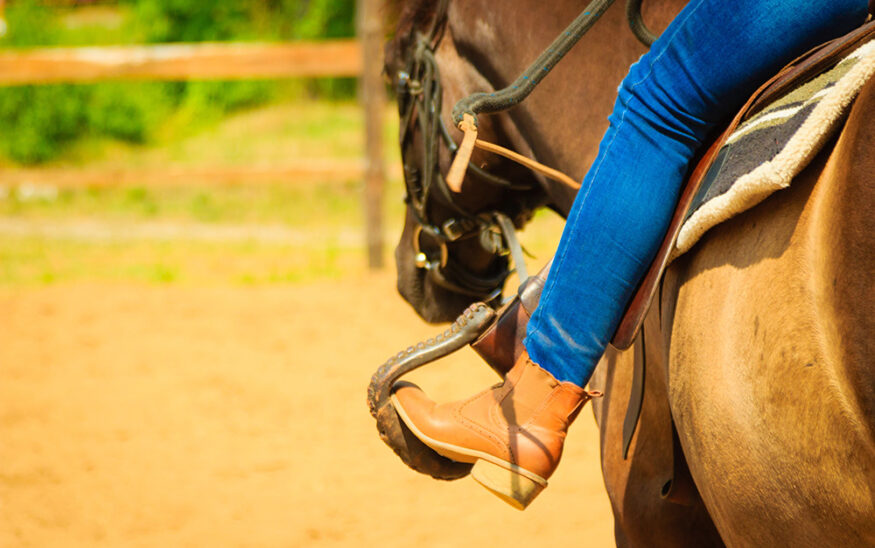
During Post’s lesson, the tack, defined in the opinion as “stable gear especially: articles or harness (such as saddle and bridle) for use on a saddle horse,” broke on the horse she was riding. Post subsequently fell from the horse and sustained injury.
Specifically, Post stated she was cantering on the horse when “she was thrown from her horse after the tack … snapped.” She said she secured the tack to the horse and “did not inspect nor was she qualified to inspect the tack.”
Post filed a negligence action against Pines Horse Farm, claiming the farm “failed to maintain the tack” used during the lesson and failed to warn of the tack’s defective condition that they “knew or should have known” existed.
Pines Horse Farm moved for summary judgment, arguing that Post could not recover because she had executed a waiver and release of liability pursuant to Va. Code § 3.2-6202, which limits the liability of “equine activity sponsors” to limited exceptions.
In its motion, Pines Horse Farm claimed Post did not allege intentional injury or violations to any of the exceptions to the liability prohibition in Va. Code § 3.2-6202(A).
The Williamsburg/James City County
Circuit Court granted the motion for summary judgment and denied Post’s motion for reconsideration. Post subsequently appealed.
Liability
The crux of Post’s appeal centered around one question: whether Pines Horse Farm can be held liable for her injury under Va. Code § 3.2-6203(2).
The statute in relevant part limits the liability of equine activity sponsors to three circumstances: intentional injury, commission of an act or omission “that constitutes negligence for the safety of the participant and such act or omission caused the injury” unless expressly assumed by the rider, or knowingly providing faulty equipment or tack.
Post argued that she was provided with faulty tack, which led to it snapping when the horse moved a certain way, causing her fall and injury.
“Post argues that but for the faulty tack snapping, she would have regained her balance and not fallen from the horse,” Frucci
wrote. “Thus, Post submits that Pines Horse Farm ‘commit[ted] an act or omission that constitutes negligence’ and that ‘such act or omission caused [her] injury.’”
Pines Horse Farm argued that by signing the release and waiver, Post assumed the risk that caused her injury. The farm indicated specific language that stated that a fall “may result in injury to the rider.”
Although an injury from receiving faulty tack was not listed in the release form, Pines Horse Farm asserted that the acknowledgement of the injury from a fall meant Post assumed “risk of falling and suffering injury for whatever cause.”
Frucci disagreed.
“A general acknowledgment that falling from a horse is possible and that it may cause injury is insufficient to absolve Pines Horse Farm from all negligent acts and omissions that could lead to participants falling from their horse, and it is not an express assumption of the risk causing the injury under Code § 3.2-6203(2),” Frucci
wrote.
The appeals court held that because the risk of receiving faulty tack was not expressly assumed by Post in the release form, the summary judgment was granted in error by the circuit court.
Frucci indicated in a footnote that the mere pleading by Post that Pines Horse Farm “should have known” about the defective tack “suffices at the summary judgment stage to allege negligence,” allowing her claims to continue.
“Post did not expressly assume the risk of receiving faulty tack, and her general assumption of the risk that she could fall from her horse is insufficient to expressly assume the risk of receiving faulty tack,” Frucci wrote. “Thus, Post sufficiently alleged that Pines Horse Farm is liable for her injury under Code § 3.2-6203(2).”
Post v. The Pines Horse Farm and Sanctuary LLC
ISSUE Does a signed waiver and release form bar an injured horse rider from making a negligence claim against the horse’s owner?
DECISION No (Court of Appeals of Virginia)
LAWYERS Joshua D. Barbosa, Williams DeLoatche, Virginia Beach (for appellant); G. Christopher Jones Jr., Sinnott, Nuckols & Logan, Midlothian (for appellee)
“In essence, Pines Horse Farm argues that the assumption of risk inquiry must end at ‘falls from a horse,’ ignoring the facts alleged thereafter that gave rise to the fall. Following this logic and interpretation of what it means to expressly assume the risk of injury would lead us to an absurd result.”
– Judge Steven C. Frucci, Court of Appeals of Virginia
Related Articles
Related Content













Verdicts & Settlements
- Medical Malpractice- Patient has bladder injury during colostomy reversal
- Premises Liability- Apartment guest burned by gas grill spewing fire
- Motor Vehicle Negligence – Physician sustained hand injuries in crash
- Premises Liability- Dog bite injury nets settlement
- Motor Vehicle Negligence – Woman suffers injuries after T-bone collision
- Negligence and Tort -Hit by hockey puck, camper sustains TBI
- Medical Malpractice – Patient suffers stroke from ruptured aneurysm
- Premises Liability- Man suffers paralysis after bench tipped back
- Medical Malpractice – Botched tubal ligation results in childbirth
- Motor Vehicle Negligence – Pickup truck passenger dies from crash injuries
- Medical Malpractice-Patient received spleen injury during colonoscopy
Opinion Digests
- Zoning – Neighbors’ challenge to 24 new townhouses fails
- Constitutional – Dispute between church and presbytery is reinstated
- Sanctions – Attorney sanctioned for violating multiple Rules of Professional Conduct
- Criminal – Sex offense defendant ineligible for sentence reduction
- Patent and trademark – Patent infringement suits to remain in EDVA
- Civil Procedure – Court finds diversity after ignoring fraudulently joined party
- Criminal – Defendant was wrongly convicted of purchasing lion cubs
- Patent and trademark – News publication enjoined from rebranding itself as “The Star”
- Employment – Government prevails on discrimination and retaliation claims
- Employment – FMLA retaliation claim survives motion to dismiss
- Employment – Physicians’ RICO claims against UVA are dismissed
- Insurance – Carrier prevails in coverage dispute
