


 Free Newsletter

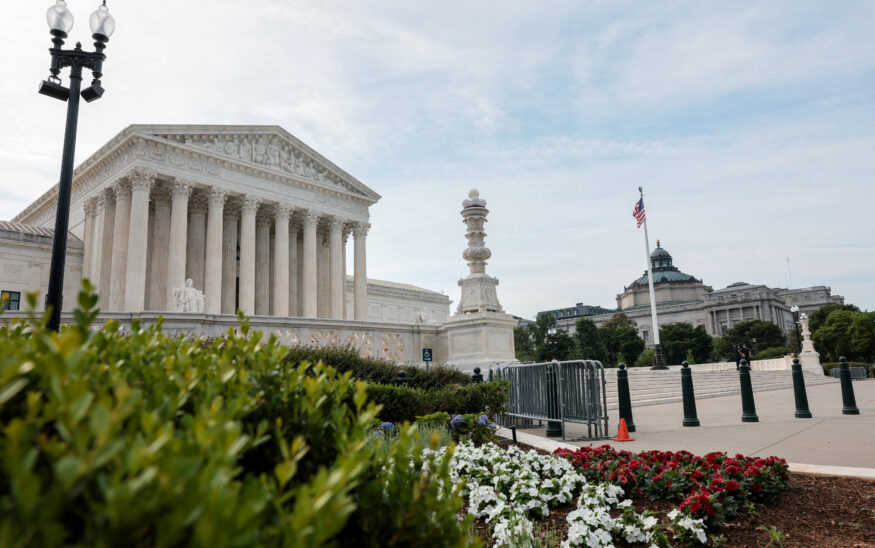
FILE PHOTO: A general view of the U.S. Supreme Court in Washington, D.C., U.S., June 22, 2026. REUTERS/Kylie Cooper/File Photo
Trump’s power takes center stage in US Supreme Court’s home stretch
Reuters//June 24, 2026//


Summary:
- U.S. Supreme Court weighs multiple trump presidential power cases
- Court conservative majority includes three justices appointed by trump
- Court struck down trump’s global tariffs under national emergencies law
June 24 (Reuters) – The U.S. Supreme Court’s current term is rapidly approaching a climactic finale in which some of its biggest cases yet to be decided will test Donald Trump‘s aggressive efforts to expand presidential authority.
The court issued five rulings on Tuesday, with more expected on Thursday. Its annual terms run from early October to around the end of June, sometimes spilling into July. The court has not announced when it will wrap up its term and begin a summer recess.
The court often waits until the end of its term to issue its most consequential rulings. This year is unusual for the number of major cases lingering that involve the critical issue of presidential power — and Trump’s particularly bold use of it.
The cases involve his efforts to limit birthright citizenship, fire Federal Reserve Governor Lisa Cook, oust Democratic members of independent agencies and terminate a humanitarian legal status protecting hundreds of thousands of Syrian and Haitian immigrants from deportation.
BLOCKBUSTER CASES
“It’s totally normal for the most important cases of the term to come out in the last few days. What is unusual is that there are so many blockbuster cases,” said University of Michigan constitutional law professor Sam Erman, an expert on the Supreme Court.
“We’ve seen a lot of novel uses of presidential power since Trump took office, and that’s produced some big questions about the nature of government and how presidential power works. So that’s produced a very active Supreme Court term, and a big bang at the end,” Erman said.
Trump has pushed to expand presidential powers during his second term in office in domestic affairs and foreign policy, drawing hundreds of legal challenges on numerous fronts.
The Supreme Court, whose 6-3 conservative majority includes three justices Trump appointed during his first term, has shown it is receptive, backing many of his emergency requests to implement policies impeded by ?lower courts while litigation over their legality continues.
Over the years, the court’s conservative majority has increasingly embraced a legal theory called the “unitary executive” that places power over the U.S. government’s executive branch solely in the hands of the president.
But the embrace may have its limits. Of the major Trump cases on which the justices heard arguments, many court watchers have predicted that Trump has a better chance of vindicating his firings of independent federal commission members than his actions on birthright citizenship or Cook.
“They have a view of a strong executive, but it’s not an unlimited executive,” Erman said of the conservative justices. “So when he is essentially advancing their project, he’s pretty likely to win.”
The court is unlikely to be sympathetic that Trump, through an executive order, can restrict birthright citizenship, Erman said.
The Republican president’s order, a politically charged part of his hardline immigration approach, would upend a longstanding interpretation of the Constitution’s 14th Amendment provision recognizing the citizenship of people born in the United States.
A REBUKE ON TARIFFS
The court already delivered a major rebuke of Trump’s audacious wielding of power, striking down in February sweeping global tariffs that he had imposed under a law meant for national emergencies. That ruling prompted Trump to lash out at the court in general and disparage the justices who ruled against him.
Other major cases that do not directly involve Trump, including those that will impact elections, transgender rights, and state firearms laws, also remain to be decided.
The court is weighing a challenge by Republicans in Mississippi to a state law that allows a five-day grace period for mail-in ballots received after Election Day to ?be counted — a case that could lead to stricter voting rules around the country.
In a case involving Vice President JD Vance, the court is also set to rule on a Republican-led bid to strike down on free speech grounds federal limits on spending by political parties in coordination with candidates.
The court’s conservative majority in April gutted a pillar of the Voting Rights Act, a landmark 1965 civil rights law that aimed to prevent racial discrimination in voting.
That ruling prompted a frenzied round of redistricting across the South to eliminate U.S. House of Representatives districts where Black voters make up a majority or ?near-majority, as Republican-led states scrambled to take advantage of the decision. The Republicans are seeking to retain control of Congress in the November midterm elections. Black voters tend to support Democratic candidates.
The court is also weighing, in cases from West Virginia and Idaho, whether to uphold state laws banning transgender athletes from female sports teams amid escalating efforts nationwide to restrict the rights of transgender people.
On gun rights, the court is set to deliver its judgment on a challenge — backed by Trump’s administration — to a Hawaii law that restricts the carrying of handguns on private property open to the public, like most businesses, without the owner’s permission.
The court last week unanimously rejected a position taken by Trump’s administration that had threatened the gun rights under the Constitution’s Second Amendment of millions of Americans who ?use marijuana and own firearms.
(Reporting by Andrew Chung; Editing by Will Dunham)
Related Articles
Related Content













Verdicts & Settlements
- Workers’ Compensation – Struck in face by forklift, woman suffers brain injury
- Negligence and Tort – Group home resident falls, sustaining femur fracture
- Medical Malpractice – Nursing facility patient dies after fracturing ankle in fall
- Medical Malpractice- Patient has bladder injury during colostomy reversal
- Premises Liability- Apartment guest burned by gas grill spewing fire
- Motor Vehicle Negligence – Physician sustained hand injuries in crash
- Premises Liability- Dog bite injury nets settlement
- Motor Vehicle Negligence – Woman suffers injuries after T-bone collision
- Negligence and Tort -Hit by hockey puck, camper sustains TBI
- Medical Malpractice – Patient suffers stroke from ruptured aneurysm
- Premises Liability- Man suffers paralysis after bench tipped back
Opinion Digests
- Insurance – Two carriers disagree over duty-to-defend responsibility
- Criminal – Inmate denied certificate of appealability on § 2254 petition
- Tort – Defamation suit reinstated against employer
- Criminal – Clothed grab-and-shake of genital area wasn’t obscene sexual display
- Criminal – Witness describe how defendant shot victim
- Wills and trusts – Trial court violated administrator’s due process rights
- Criminal – Evidence supported joint possession of firearm jury instruction
- Criminal – Ample evidence supports murder conviction
- Negligence – Suit alleges business negligently designed and maintained premises
- Prisons – Inmate’s petitions for sentence reduction rejected
- Criminal – Man convicted of sexual battery of 12-year-old stepdaughter
- Freedom of information – FOIA suit remanded following developments on appeal
