


 Free Newsletter

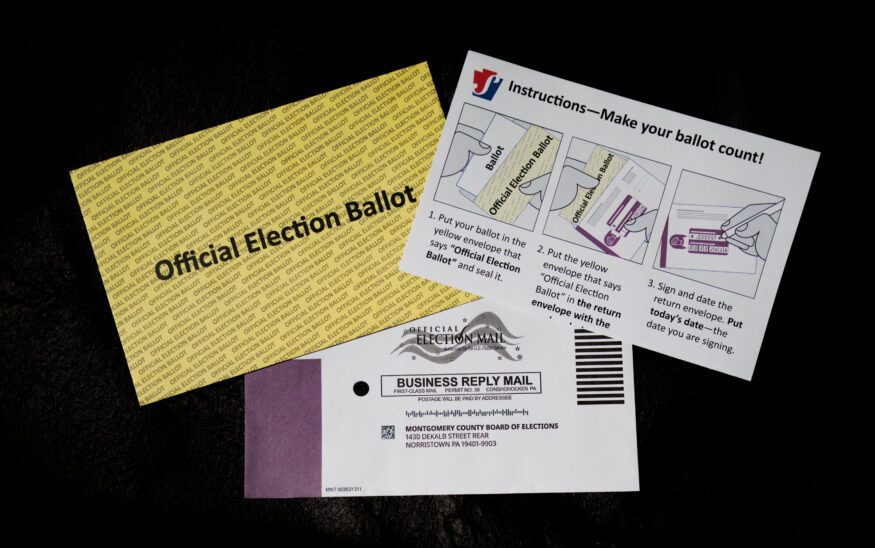
A mail-in ballot, during the Pennsylvania primary election, is displayed in this illustration picture taken in Philadelphia, Pennsylvania, U.S., May 19, 2026. REUTERS/Hannah Beier/Illustration
Supreme Court asks Trump administration views on Pennsylvania mail-in ballot dispute
Reuters//June 29, 2026//


Summary:
- U.S. Supreme Court considers Republican appeal on ballot date rule
- 3rd U.S. Circuit Court of Appeals ruled against date requirement
- Over 10,000 ballots discarded in 2022 election due to missing dates
June 29 (Reuters) – The U.S. Supreme Court asked President Donald Trump‘s administration on Monday for its views on whether or not it should hear a Republican bid to enforce Pennsylvania‘s requirement that election officials throw out mail-in ballots lacking a handwritten date on the outer envelope.
Critics have said the mandate needlessly disqualifies thousands of valid ballots. Proponents have said it is important in combating election fraud.
The justices are considering taking up an appeals by Republican Pennsylvania Attorney General David Sunday and national and state Republicans of a lower court’s ruling that blocked the requirement, which is part of the state’s election law, as a violation of the U.S. Constitution’s protections of the right to vote.
Pennsylvania often is pivotal in determining the outcome of U.S. presidential elections, as it again was in 2024 when Republican President Donald Trump won the state over his Democratic rival Kamala Harris, after losing it to Democrat Joe Biden when he was defeated in the 2020 U.S. election.
Democratic voters traditionally are more likely to use mail-in ballots than Republican voters.
The requirement mandates that Pennsylvanians who vote by mail place their secret ballot into an outer return envelope, on which they must sign and date a declaration that they are qualified to vote.
In the current case, a legal challenge was brought by a Democratic voter who had her mail-in ballot rejected during the 2022 general election for failing to write the date on her return envelope, as well as by the Democratic Congressional Campaign Committee and other groups.
The plaintiffs said the requirement serves no valid purpose, including to detect fraud, and violates the right to vote, which the Supreme Court in various precedents has said is covered by the rights to free speech and association under the Constitution’s First Amendment and to equal protection and due process under its 14th Amendment.
The Republican National Committee and the state Republican party intervened to defend the ballot rule.
The plaintiffs said the ballot requirement caused officials to discard more than 10,000 ballots in the 2022 general election, and — after a ballot envelope redesign — 4,500 in the 2024 election, due to missing or incorrect dates.
A federal judge ruled that enforcing the ballot date is unconstitutional, finding that the Republican contention that it promotes election efficiency and integrity lacked evidence.
The Philadelphia-based 3rd U.S. Circuit Court of Appeals in August 2025 upheld the judge’s decision, ruling that “discarding thousands of ballots every election is not a reasonable trade-off in view of the date requirement’s extremely limited and unlikely capacity to detect and deter fraud.”
“Because of the Commonwealth’s date requirement, an inadvertent typographical error or a flipped number or even a stray pen mark in the date field will remove the ballot contained within the return envelope from consideration. And the voter may never be the wiser,” the 3rd Circuit said, referring to Pennsylvania.
The U.S. Supreme Court in January 2025 left in place a previous ruling by the 3rd Circuit rejecting a challenge to the date requirement brought by plaintiffs including the Pennsylvania State Conference of the NAACP. Those plaintiffs had argued that the mandate played no relevant role in the voting process and caused unnecessary disenfranchisement.
In that case, the 3rd Circuit rejected the argument that the measure violated a federal law that bars discarding ballots due to paperwork errors that are “not material” in determining whether a person is qualified to vote.
Trump, who has made false claims about widespread fraud in U.S. elections, has long sought to cast doubt on the security of mail-in ballots, although evidence of fraud is rare. Trump issued an executive order in March to restrict mail-in ballots nationwide, but a federal judge in Boston on June 25 blocked its implementation.
(Reporting by Andrew Chung; Editing by Will Dunham)
Related Articles
Related Content














Verdicts & Settlements
- Medical Malpractice – Jurors side with doctor in suit over rescue surgery
- Workers’ Compensation- Seasonal worker paralyzed in tobacco baler accident
- Medical Malpractice- Death from cancer followed stomach pain misdiagnosis
- Workers’ Compensation – Struck in face by forklift, woman suffers brain injury
- Negligence and Tort – Group home resident falls, sustaining femur fracture
- Medical Malpractice – Nursing facility patient dies after fracturing ankle in fall
- Medical Malpractice- Patient has bladder injury during colostomy reversal
- Premises Liability- Apartment guest burned by gas grill spewing fire
- Motor Vehicle Negligence – Physician sustained hand injuries in crash
- Premises Liability- Dog bite injury nets settlement
- Motor Vehicle Negligence – Woman suffers injuries after T-bone collision
Opinion Digests
- Criminal – Man fails to vacate default judgment forfeiting approximately $21,000
- Negligence – Business not liable for failing to call ambulance
- Search & Seizure – Police lacked reasonable suspicion for stop and frisk
- Criminal – Man convicted of pinching officer during struggle
- Municipal – Heirs claim surplus funds following tax sale of real property
- Contract – Res judicata bars some of breach of contract claim
- Criminal – Circuit court’s probation decision is reversed
- Employment – Virginia court had subject-matter jurisdiction over remote worker’s claims
- Criminal – Record supports sentencing decision
- Insurance – Two carriers disagree over duty-to-defend responsibility
- Criminal – Inmate denied certificate of appealability on § 2254 petition
- Tort – Defamation suit reinstated against employer
