


 Free Newsletter

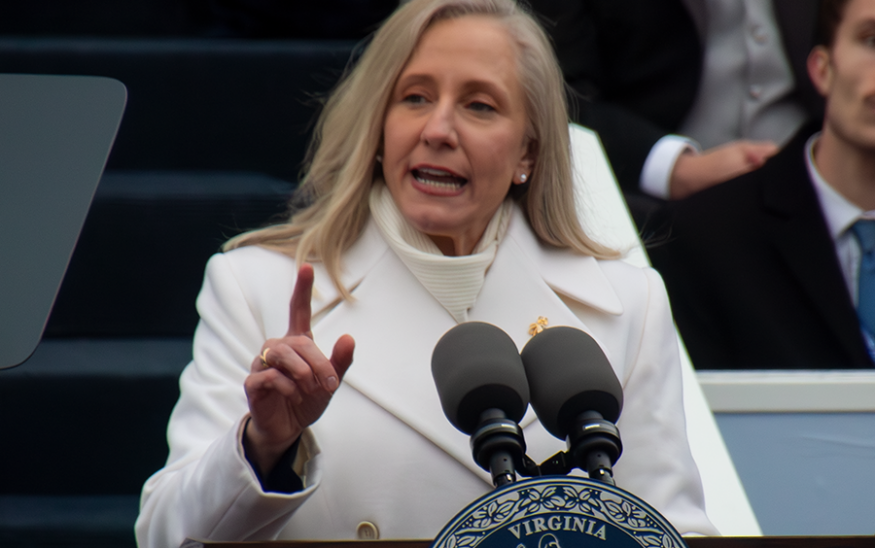
Virginia Gov. Abigail Spanberger was sworn in as Virginia’s 75th governor, the first woman to hold the office, on Jan. 17, 2026. Photo by Kira Jenkins/Virginia Business
Spanberger vetoes courthouse security bill
Jason Boleman//May 22, 2026//


Summary:
- Gov. Abigail Spanberger vetoes Senate Bill 83 and House Bill 1392
- Exemption for attorneys with Virginia State Bar card opposed
- Senate Majority Leader Scott Surovell criticizes veto
Gov. Abigail Spanberger has vetoed legislation that would have changed courthouse security procedures, making policies uniform statewide.
Spanberger’s office announced Tuesday that she had vetoed Senate Bill 83 and House Bill 1392 after objecting to a proposed security exemption for attorneys entering courthouses.
Bill supporters, who described individual courthouses’ processes as scattershot with varying rules, sought to streamline protocols at all courthouses across the commonwealth.
Among the provisions was an exemption for attorneys who display a valid Virginia State Bar-issued bar card to skip security screening lines at courts where courthouse security or law enforcement officers bypass screening.
Violators who present an invalid bar card could face both a mandatory VSB disciplinary referral and a class 1 misdemeanor charge, the bills said.
In her official veto statement, Spanberger pointed to the exemption for lawyers as a sticking point for her.
“Without additional study or a clear public safety benefit, I do not support mandating new statewide security screening exemptions for attorneys at courthouses,” Spanberger said. “Any such statewide changes to security protocols should be based on clear evidence that such changes would have no impact on — or ideally, improve — public safety.”
Senate Majority Leader Scott Surovell, along with bill patrons Sen. Saddam Azlan Salim and Del. Karen Keys-Gamarra, who are all Fairfax County Democrats, released a joint statement Wednesday saying they were “deeply disappointed” by the veto. Surovell and Keys-Gamarra are attorneys.
“The veto rests on a fundamental misunderstanding of what these bills do and of the practical realities facing Virginia’s courts,” the legislators said in their statement.
Spanberger’s concern, they added, “misreads both the bills and the people they cover.
“Attorneys are licensed professionals who have passed character-and-fitness review and remain under the continuing disciplinary authority of the Virginia State Bar,” the legislators said. “They are officers of the court, bound by enforceable duties of candor and obedience to court rules.”
The legislators also noted that groups that are already allowed to skip security screenings, such as law enforcement officers, have “a documented misconduct rate higher than the population the Governor’s veto deems too risky to extend the same courtesy” and that the governor offers “no support” for the conclusion that the legislation does not contribute to public safety.
“[T]he Administration has not identified a single incident, anywhere in Virginia, at any time, in which that practice has compromised public safety,” the legislators stated, adding that as far as they were aware, the Virginia State Bar was not consulted prior to the veto.
Salim and Keys-Gamarra also said that they were not consulted by Spanberger before she vetoed the legislation. They intend to reintroduce the bill in the 2027 session, the legislators said.
However, in the meantime, “Attorneys arrive at hearings unsure whether the devices containing their trial exhibits will be admitted, forcing avoidable delay and added cost on clients and the Commonwealth alike,” the legislators said. “We respect the Governor’s constitutional prerogative, but we do not accept the premise on which this veto rests.”
SB 83 passed the Senate 26-14 and the House of Delegates unanimously before being sent to Spanberger’s desk, with the bill’s sponsors saying the legislation was backed by a petition of nearly 400 Virginia attorneys.
On April 11, Spanberger amended the bill to add a reenactment clause stating that SB 83 would not become effective “unless reenacted by the 2027 Session of the General Assembly.” The legislature did not approve the amendment when it reconvened April 22 and sent the bill back to Spanberger as originally passed.
Virginia Poverty Law Center Executive Director Jay Speer told Virginia Lawyers Weekly at that time that the reenactment clause “in effect … is a veto unless the [General Assembly] rejects her recommendation.”
This week, Speer noted that he was “pleased” that Spanberger signed House Bill 872, which requires chief judges of Virginia’s circuit, general district and juvenile and domestic relations courts to set policies regarding the use of portable electronic devices by court visitors. SB 83 had identical directions to judges, along with the attorney security screening exemption.
Related Articles
Related Content










Verdicts & Settlements
- Medical Malpractice-Patient dies following blood loss in surgery
- Motor Vehicle Negligence – Defense points to plaintiff’s prior collision, stressors
- Medical Malpractice – Ingrown toenail removal leads to CRPS type 2
- Motor Vehicle Negligence Rear-seat passenger injured when car hits telephone pole
- Motor Vehicle Negligence- Car crash after back surgery causes additional injuries
- Medical Malpractice – Jurors side with cardiologist over treatment of strokes
- Negligence and Tort- Ice pack use during tattoo removal causes frostbite
- Workers’ Compensation Struck by metal door at workplace, plaintiff sustains subdural hematoma
- Motor Vehicle Negligence Woman struck by vehicle loses senses of taste, smell
- Motor Vehicle Negligence – Pedestrian struck by car while in parking lot
- Motor Vehicle Negligence- Driver fractures right leg in tractor-trailer collision
Opinion Digests
- Freedom of Information – Exemption 5 protects draft PTAB written decision
- Fraud – Homeowners’ RICO claim is dismissed
- Criminal – Sex-offender convicted of providing false information
- Evidence – Defendants must respond to post-judgment discovery
- Patent and trademark – Several claims found to be ineligible for patent protection
- Criminal – Evidence supports robbery conviction
- Administrative – Internal Communications Among Patent Judges – Withheld Materials
- Criminal – Denial of continuance wasn’t abuse of discretion
- Criminal – Felony eluding conviction violated Double Jeopardy clause
- Criminal – Defendant was wrongly convicted of two counts of hit-and-run
- Criminal – Sexually-violent predator denied conditional release
- Constitutional – Redistricting effort violated Virginia Constitution
